TABLE OF CONTENTS

Executive Summary
GRADEpro GDT (Guideline Development Tool) is a software solution for developing, managing, and disseminating high-quality, evidence-based clinical and public health guidelines. It streamlines the entire guideline production lifecycle by supporting teams with a tailored suite of digitally enhancing and methodologically sound solutions. Used by over 150,000 scientists worldwide, the platform centralizes expert collaboration, automates key processes, and ensures transparency.
GRADEpro provides a single, dedicated workspace for all phases of guideline development: from managing conflicts of interest and appraising evidence (Evidence Tables) to achieving panel consensus (PanelVoice) and delivering rich, interactive guidelines to end-users (Visual & Interactive Guidelines Module). This approach optimizes the recommendation development process, making it cost-effective and serving as a foundation for implementing living guidelines.
1. Digitizing and automating key processes
1.1 Ensuring smooth and transparent collaboration
In GRADEpro, each guideline is a centralized project, where each team member plays a part according to their assigned role. Input collection is fully digital, organized, and tracked to simplify the process while maintaining transparency.
- PanelVoice for Consensus: This module streamlines expert decision-making by facilitating online communication, structured voting, and commenting on the EtD tables, enabling an efficient, remotely managed process for guideline panels.
- Collaborative guideline editing: Guideline document can be easily accessed and edited by all relevant team members according to custom, role-based permissions. By making every section a separate unit, conflicting edits are prevented. Tracking changes (Suggestions mode) and commenting ensure transparent and efficient collaboration.
- Questions and Outcomes generation: Together with your panel of experts you can easily brainstorm and prioritise guideline questions to address, as well as the outcomes of interest
- Team and Conflict Management: The tool manages a living guideline panel, including handling Conflict of Interest forms that follow the template of organizations like the WHO.
1.2 Providing ready-to-use frameworks
Frameworks endorsed by renowned organizations such as the WHO or the Cochrane Collaboration are readily available to be populated with systematic review data and then integrated into the guideline development process.
- Evidence (SoF) Tables: GRADEpro facilitates the generation of GRADE Evidence Profiles and Summary of Findings (SoF) tables, integrating meta-analysis results and calculating the certainty of evidence.
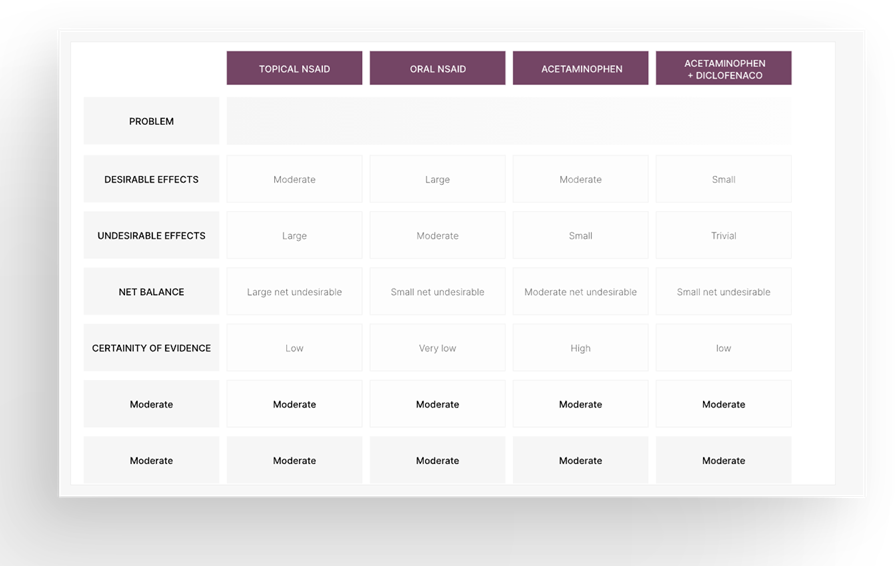
- Evidence to Decision (EtD) Framework: The Recommendations module supports various EtD templates, including the specialized WHO-INTEGRATE framework.
- Multiple intervention approach: all of the above frameworks can be used in order to determine the best intervention from a number of options with the use of Network Meta-Analysis table or by integrating multiple pairwise comparisons into a single EtD
- Adolopment: Save time and resources by adapting existing evidence from reliable sources into the local context. GRADEpro facilitates transparent contextualization.
2. Impactful dissemination
2.1 Interactive digital formats
GRADEpro transforms research outputs into high-impact, user-friendly digital formats, maximizing reach and usability for clinicians and patients.
- Interactive Data Visuals: The Visual Clinical Guidelines Module turns guidelines into a compact, digital format, allowing users to explore outcomes, adjust comparators, and view data presentations. The digital presentation is created semi-automatically based on existing content generated in GRADEpro throughout the guideline development process and can be prepared in a matter of minutes, without costly services of graphic designers
- Decision Aids: The tool features a module that allows users to create Decision Aids for shared decision making. These aids can be simple summaries or multi-page, interactive tools that help patients assess their values and preferences.
- Interactive Summary of Findings (iSoF): every set of systematic review data can be made available online as an interactive widget, including plain language explanations and helpful visualizations. iSoF can serve as a digital component of traditionally published guidelines or be incorporated into other digital formats offered by GRADEpro
2.2 Custom publication suites
Whether you publish your guidelines in journals, on your own website, or are looking for a new, dedicated publication platform, GRADEpro has a solution for you. Regardless of the selected solution, you have full control over the publication process and can update content whenever necessary, following the best practices of living guidelines.
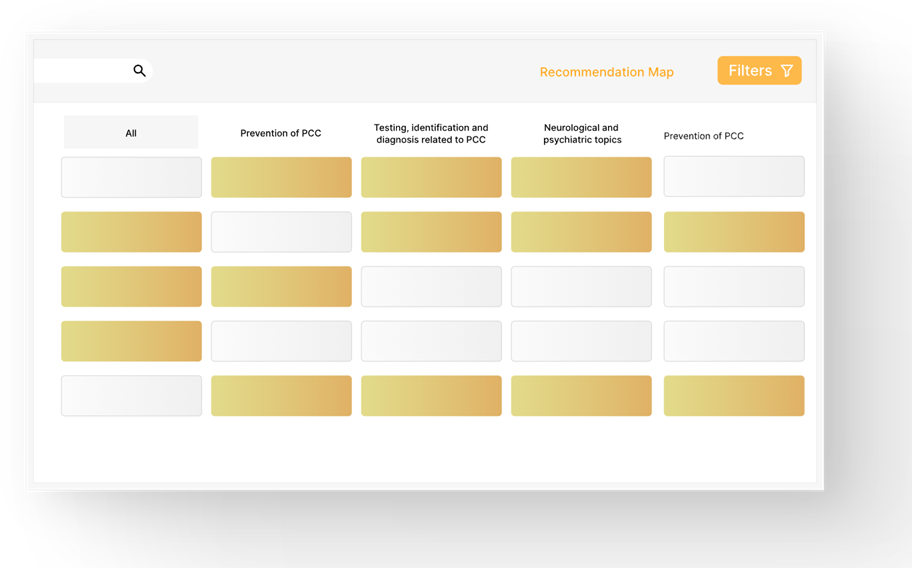
- Dedicated dissemination: Publish your work according to your needs, free of third-party branding, ensuring the public is not confused by guidelines from other organizations. You can choose to present entire traditional guideline documents, standalone recommendations, or both. Your data can be displayed as a filtered list or mapped on an interactive grid. For easy access, RecChat can be implemented.
- RecChat: A conversational AI search engine can help the audience access your guidelines and recommendations. RecChat is specifically designed to only answer questions based on your published data, provide safe and evidence-based answers, and make the content easily accessible and understandable for both specialists and the public.
- Digital Integration: The content is available via API for integration into existing websites and is used to power cross-platform solutions like mobile apps (which support full offline functionality).
- Journal Publication: GRADEpro facilitates adapting a digitally developed guideline into a scientific journal format by producing a customized Word export for submission.
RELATED ARTICLES
Was this article helpful?
That’s Great!
Thank you for your feedback
Sorry! We couldn't be helpful
Thank you for your feedback
Feedback sent
We appreciate your effort and will try to fix the article